The fluorescent lights in St. Jude’s Medical Center always had the same cruel hum at two in the morning, a thin electric whine that crawled into the skull and stayed there. Rachel Bennett had learned to tune it out over ten years of graveyard shifts, but tonight the sound seemed sharper, as if the whole building had tensed.
Everything in the emergency room funneled toward Trauma Bed Four.
Rachel stood at the bedside with a hand on the IV line, watching the drip fall with steady patience while the monitor argued with itself. Heart rate surging, then dipping. Oxygen numbers refusing to settle. A fever that had no business being that high in a man who still looked strong enough to fold a stretcher in half.
He had come in three hours earlier as a John Doe, delivered by paramedics who looked rattled even after they’d handed him off. Found slumped in an alley three blocks away. No wallet. No phone. No identification. Just tactical boots worn down at the heels, a faded gray T-shirt stuck to a body slick with sweat, and a wound along his side that made Rachel’s stomach twist the moment she saw it.
It wasn’t a bar fight cut. It wasn’t the messy tear of an accident.
It was too clean.
A deliberate incision, now angry and swollen, the edges inflamed like fire had spread under the skin.
“He’s stabilizing,” Rachel murmured, more to herself than anyone else. She pressed two fingers lightly to his wrist. “Barely.”
His lips moved in fevered whispers, words that weren’t words so much as fragments, numbers and syllables shaped by habit. Military cadence. Coordinates. The kind of sounds a body makes when the mind is stuck somewhere else.
She reached for a damp cloth and dabbed his forehead. His skin burned under her fingers.
“Nurse Bennett.”
The voice sliced through the bay with the crispness of authority.
Rachel’s shoulders tightened before she even turned. Dr. Gregory Alcott stood at the entry with his chart in hand, white coat pressed, hair perfect, expression sharpened into displeasure. He was new enough to still smell faintly of cologne, not antiseptic. New chief of surgery. The kind of man who spoke in billing codes and measured compassion in reimbursement.
His gaze flicked to the muddy tactical boots near the corner as if they were an insult.
“Yes, Doctor?” Rachel said.
Alcott flipped through the chart like he was searching for a reason to be offended. “Why is this vagrant occupying a trauma bed?”
Rachel kept her face neutral. “He came in septic. He’s critical.”
“No insurance,” Alcott snapped. “No identification. No family. We are not a homeless shelter. Transfer him to county.”
Rachel’s hands paused over the IV line. She looked up slowly, meeting his eyes.
“Dr. Alcott, he’s in septic shock. His heart rate is erratic. If we move him, he can arrest. This infection looks like battlefield staph. He needs IV antibiotics and observation.”
Alcott’s mouth tightened. “You’re a nurse. You follow orders.”
“He’s a human being,” Rachel said, the words coming out before she could soften them. “And I think he’s a veteran. Look at the scarring. Shrapnel, maybe.”
“I don’t care if he’s the King of England,” Alcott said, voice dropping colder. He leaned closer, lowering it like a private threat. “You have fifteen minutes to clear this bed. If I come back and he’s still here, it won’t be him leaving this hospital. It’ll be you.”
He turned and marched out, coat flaring behind him.
Rachel stood there for a moment, jaw clenched, listening to the hum of lights and the soft hiss of oxygen. Her pulse beat in her throat.
Protocol said obey.
Everything else in her said don’t.
She looked down at the man in the bed. His breathing was shallow, the kind that made a nurse’s skin itch with urgency. He twitched once, as if trying to run in a dream.
Rachel checked the clock.
2:15 a.m.
Alcott would vanish to his office for his usual nap and show back up for rounds around 6:30. That gave her time, and it gave her one chance to keep him alive.
She moved fast and quietly. She wheeled Bed Four to the far corner of the bay, behind a heavy privacy curtain usually used as a makeshift storage space. She overrode the medication cabinet for vancomycin, fingers steady while her stomach roiled at what she was doing. Expensive antibiotic. Restricted access. A digital trail with her name on it.
She didn’t care.
She hung the new bag, watched the drip, then sat beside him with a basin of cool water, sponging his forehead, his neck, the places heat pooled. His fever fought her like a living thing.
For four hours, Rachel traded favors and silent nods with the other nurses to cover her beds. She moved between patients with practiced calm while her mind stayed anchored on the hidden man behind the curtain. Every time she went back, he was still burning, still murmuring.
“Echo Two… position compromised…” he groaned, voice rough with pain. “Get the bird out…”
“You’re safe,” Rachel whispered, leaning close. “You’re at St. Jude’s. I’m Rachel. I’m not going anywhere.”
By 5:30, the fever finally broke.
It didn’t disappear, but it loosened its grip. His skin cooled from scalding to merely hot. His heart rate steadied. Rachel felt the shift in the room before the monitor even confirmed it.
Then his eyes opened.
Steel gray, instantly alert despite the weakness in his body, like someone had flicked a switch under the exhaustion.
He tried to lift his head.
“Easy,” Rachel said, pressing a hand to his shoulder. “Hospital. You were in bad shape. Septic shock.”
His gaze tracked her face like he was memorizing it. He winced, hand moving to his infected incision, fingers instinctive and precise.
“You stayed,” he rasped.
“I stayed.”
His eyes narrowed slightly. “Someone wanted me gone.”
It wasn’t a question. It was a fact delivered like a report.
Rachel swallowed. “Dr. Alcott wanted to discharge you to county. I… hid you instead.”
For a flicker of a second, something passed over his face. Surprise. Gratitude. Something else she couldn’t name.
“Thank you,” he said, and his voice held weight. “I need to make a call. There’s a number…”
The curtain exploded open.
Plastic rings screeched down the rail. Dr. Alcott stood there with two hospital security guards at his back, his face flushed purple with rage.
“I warned you, Bennett,” Alcott hissed. “You defied a direct order. You stole medication. You misappropriated resources.”
Rachel stepped instinctively between him and the patient. “He would have died,” she said. “Look at him. He’s conscious. The antibiotics worked.”
“I don’t care,” Alcott shouted, loud enough to make heads turn beyond the bay. “Get him out of here. And you…” He pointed at her like she was something stuck to his shoe. “Your badge. Now.”
The guards hesitated.
Everyone knew Rachel. She was the nurse who stayed late, who remembered people’s kids, who held hands when families got the worst news of their lives. The kind of nurse hospitals marketed in glossy brochures while administrators tried to replace her with cheaper labor.
But fear works fast.
One guard, Frank, wouldn’t meet her eyes. “I’m sorry, Rachel.”
Rachel unclipped her badge. The plastic felt heavier than it should. She removed her stethoscope too, the one her father had given her on graduation day, and set both on the bedside table like she was laying down a part of herself.
She turned to the man in the bed. “You’re stable,” she said quietly. “Don’t let them move you until you’re ready. Drink water.”
His gaze shifted to Alcott, and Rachel felt cold crawl up her spine at the look on his face. Not anger.
Calculation.
Under the sheet, his hand tapped a faint rhythm against his thigh, as if counting seconds.
Alcott leaned in close to Rachel. “Get out,” he hissed.
Rachel grabbed her purse and coat and walked out with her head high, even as something inside her cracked. Ten years of nights and weekends and holidays, erased because she wouldn’t let a man die for a budget line.
The automatic doors slid open, and cold morning air slammed into her. Rain fell in a miserable stinging drizzle that soaked through her scrubs in seconds. She stood on the sidewalk staring back at St. Jude’s, the building that had been her whole adult life.
Her car was still in the shop.
The next bus didn’t run until seven on Sundays.
It was barely 6:15.
Her apartment was five miles away.
“Perfect,” Rachel muttered, wiping water off her face with the back of her hand.
She started walking.
Her rubber nursing clogs squeaked on wet pavement. Cars shot past and threw dirty water onto her legs. She clutched a small cardboard box Alcott had “allowed” her to pack, a sad little collection of ten years boiled down to a coffee mug, spare socks, and a photo of her dog.
At first, anger kept her warm.
Then the anger drained out, replaced by the slow, crushing fear that always came afterward.
Rent. Bills. Her license. Her reputation. Alcott would make sure no hospital in the city touched her. Fired for insubordination, for “misusing resources.” The narrative wrote itself.
Rachel walked with her shoulders hunched against the rain, telling herself not to cry because crying made you miss your footing, and slipping on wet pavement felt like the universe piling on.
She was about two miles from the hospital when she heard it.
A low thrumming that didn’t belong to traffic, a vibration that seemed to settle directly in her chest. She stepped off the shoulder into the grass, thinking maybe a truck was coming too close.
But the sound wasn’t behind her.
It was above.
Rachel stopped and looked up through the rain and mist.
Two shapes materialized out of the gray like shadows solidifying.
Black helicopters.
Not the red-and-white medical choppers she recognized. These were matte black, bristling with antennas, built for places where people didn’t ask permission.
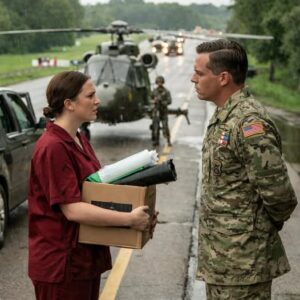
The lead helicopter dropped lower, nose flaring as it slowed. The downdraft hit the road like a physical force. Rachel’s cardboard box tore from her hands and burst open. Her coffee mug shattered across the asphalt. The photo of her dog tumbled into wet grass.
She crouched instinctively, arms over her head, heart pounding so hard it hurt.
The helicopter landed directly on the highway, skids settling in the middle of four lanes, blocking traffic like the road belonged to it. The second touched down in the adjacent field, grass flattening in circles beneath it.
Before the rotors even finished settling, doors slid open and men jumped out.
Not soldiers in generic fatigues. These men moved differently. High-end gear. Tight formation. Precision that made Rachel’s skin prickle with instinctive unease.
One of them, huge and bearded with a scar through his eyebrow, sprinted toward her and stopped several feet away, hands raised to show he wasn’t a threat.
“Ma’am!” he shouted over the roar. “Are you Nurse Rachel Bennett?”
Rachel stared at him, rain streaming down her face, mouth open but useless.
“Ma’am, look at me,” he said, voice firm but not cruel. “Are you the nurse who treated the John Doe at St. Jude’s?”
Her throat worked. She nodded once.
“Yes.”
The man tapped his headset. “Command, we have the asset. We have the angel.”
Rachel flinched at the word angel. It felt ridiculous and terrifying at the same time.
The operator extended his hand. “You need to come with us.”
Rachel backed against the guardrail, palms up. “What? Why? I was fired. I didn’t do anything wrong.”
“We know,” he said, and his expression softened. “That man you treated is Captain Elias Thorne. Delta Force. He’s our team leader.”
The world tilted.
“Captain Thorne woke up enough to make one call,” the operator continued. “He told us what happened. He said they threw you out for saving his life.”
Rachel’s breath caught. “He… he’s awake?”
“Barely,” the operator said. “General Higgins is already at the hospital.”
He watched her face carefully, then added, “Captain Thorne refuses further treatment unless you’re brought back. His words were: ‘Get me the nurse who refused to let me die, or I walk out with my IVs trailing behind me.’”
Rachel stared at his outstretched hand as rain hammered her shoulders. Her mug lay in pieces on the road. Her life, the one she’d thought she understood, felt just as shattered.
And yet, for the first time since Alcott screamed in her face, she didn’t feel small.
She took the man’s hand.
Someone wrapped a warm blanket around her shoulders as they guided her toward the helicopter. As she climbed into the cabin and the door slid shut, the roar of the rotors swallowed everything else.
The helicopter lifted off, banking toward St. Jude’s.
Rachel looked down at the wet highway and the stalled cars below.
Five minutes ago she’d been a fired nurse walking home in the rain.
Now two Black Hawks were carrying her back.
And whatever waited at St. Jude’s, she could feel it in her bones.
This wasn’t over.
The Black Hawk set down on the roof of St. Jude’s with a violence that rattled the upper floors. The skids scraped concrete, rotors whipping rain into horizontal sheets, alarms chirping somewhere deep inside the building as if the hospital itself were protesting what was happening to it.
Rachel barely had time to brace before the door slid open and cold air rushed in.
Hands guided her out, firm but careful. Someone adjusted the blanket around her shoulders. The men moved fast, purposeful, already forming a perimeter as if the roof were hostile territory.
She caught sight of the city below for a split second, then the roof access door was wrenched open and they were inside, boots pounding down a concrete stairwell that smelled of dust and old paint.
Rachel’s heart hammered. Every step back into the building felt unreal. Ten minutes ago she had been fired, dismissed, erased. Now armed men were escorting her through restricted corridors like she belonged there more than anyone else.
They took the service elevator. It descended in silence except for the soft clink of gear and the distant whir of rotors fading overhead.
When the doors opened onto the ER level, the floor was chaos.
Doctors froze mid stride. Nurses stared openly. A security guard dropped his radio. Conversations died in half sentences.
At the nurse’s station, Dr. Gregory Alcott was shouting into a phone, face flushed, tie loosened.
“I do not care who they think they are,” he snapped. “This is private property. Get those aircraft off my roof or I will personally sue the city, the hospital board, and the Pentagon if I have to.”
The elevator doors chimed.
Six operators stepped out first, spreading smoothly, silently. In their center walked a tall man in dress uniform, his movements deliberate, his presence bending the room around him. He leaned slightly on a cane, the mark of an old injury, but his posture was rigid with authority.
General Thomas Higgins.
And beside him, wrapped in a gray military blanket, was Rachel Bennett.
The ER went dead silent.
Alcott turned, irritation already loaded on his tongue. Then he saw the general. Then he saw Rachel.
The color drained from his face in stages.
“What is the meaning of this,” Alcott demanded, though his voice wavered.
General Higgins did not slow until he was inches away. “Are you Dr. Gregory Alcott.”
“I am the chief of surgery,” Alcott said, lifting his chin. “And you are trespassing.”
“No,” Higgins replied calmly. “This is the location of a high value asset under federal protection. An asset you attempted to discard.”
He turned slightly, gesturing to Rachel. “Nurse Bennett is no longer your employee. She has been conscripted as a specialized medical consultant under my authority. Effective immediately, she outranks you.”
A ripple of stunned murmurs spread through the ER.
“If she asks for supplies, you provide them,” Higgins continued. “If she asks for staff, you assign them. If she asks for silence, you shut your mouth.”
Alcott’s lips trembled. “She is incompetent. She stole medication. She defied orders.”
Rachel stepped forward before Higgins could answer.
“Where is my patient,” she asked, her voice steady.
Alcott crossed his arms, defiance flaring like a last match. “I transferred him to the basement holding area pending county transport. He is no longer my responsibility.”
Rachel’s stomach dropped.
“The basement is cold,” she said sharply. “He is septic. Hypothermia will send him into shock.”
She did not wait for permission. She broke into a run toward the service elevators, the blanket slipping from her shoulders. Two operators moved with her instantly.
The basement smelled of rust and old concrete. Broken gurneys and discarded equipment lined the walls like forgotten bones. Rachel spotted him immediately.
Captain Thorne lay on a stretcher with one bent wheel, teeth chattering violently, skin pale and damp. His IV line had backed up, blood dark in the tubing.
“Elias,” she said, rushing to his side.
His eyes fluttered. “Rachel,” he murmured. “South ridge. Hostiles.”
“No hostiles,” she said firmly, pulling off her jacket and wrapping it around his chest. “Get blankets. Now.”
The operators moved without question.
They rushed him back upstairs, the ICU already being secured into something closer to a military command post. Rachel worked on instinct, hands moving without hesitation. Warm fluids. Fresh IVs. Continuous monitoring.
The numbers improved slightly, but something felt wrong.
She stared at the labs as they came in, brows knitting. “This does not look right,” she muttered. “White count is off pattern. This is not standard infection.”
Alcott appeared in the doorway, pale but still sneering. “Battlefield sepsis. You are overreacting.”
“No,” Rachel snapped, turning on him. “General, where was he injured. I need the environment.”
“That information is classified,” Higgins said carefully.
“General,” Rachel said, meeting his eyes, “your son is dying. Classification can wait.”
Higgins hesitated, then exhaled. “Golden Triangle. Raid on a synthetic opioid facility. Unknown compounds.”
Rachel’s eyes sharpened. “Chemical exposure. Neurotoxic. It is mimicking infection while suppressing autonomic response.”
“That is absurd,” Alcott said. “You will kill him.”
The heart monitor screamed.
“V fib,” a nurse shouted.
Rachel shoved Alcott aside and grabbed the crash cart. “Charge to 200.”
The shock hit. No response.
“Three hundred. Clear.”
Flatline.
Rachel climbed onto the bed, starting compressions, breath burning in her chest. “Do not you dare die on me,” she muttered.
“Stop,” Alcott said coldly. “You have killed him.”
A gun clicked.
Rachel glanced up to see General Higgins aiming his sidearm at Alcott. “Say another word.”
“Hold compressions,” Rachel said suddenly.
The monitor blipped.
Once. Twice.
“Sinus tachycardia,” she breathed. “He is back.”
She grabbed atropine and pushed it without hesitation. “If I am wrong, this stops his heart. If I am right, he stabilizes.”
Ten seconds. Twenty.
The heart rate slowed. Blood pressure climbed.
Rachel sagged against the bed rail, knees weak. “It was toxin exposure.”
Higgins holstered his weapon. “Lock Alcott in his office. If he touches a phone, restrain him.”
Three days passed.
Rachel slept on a cot in the ICU, waking every hour to check vitals. By the third day, Elias was awake, weak but lucid.
“You have a heavy hand,” he rasped.
“You have terrible veins,” Rachel replied, adjusting his pillow.
Before either could say more, a man in scrubs entered, head down, pushing a medication cart.
“Scheduled sedation,” he muttered.
Rachel frowned. “I handle all meds for this patient.”
The man froze.
Her gaze dropped to his shoes. Leather. Expensive. Then to his wrist.
A black scorpion tattoo.
“Step away from the cart,” Rachel said sharply.
The man looked up. His eyes were empty. He reached into his pocket.
“Gun,” Elias shouted.
Rachel reacted without thinking. She grabbed a metal tray and hurled it. The shot went wide, shattering glass. The assassin staggered, raised the gun again.
Elias ripped out his IVs and tackled him, but the man was stronger. He threw Elias aside and turned toward Rachel.
She grabbed the oxygen tank and swung with everything she had. The crack echoed through the room. The man collapsed.
Operators flooded in seconds later.
“They found us,” Higgins said grimly. “We are compromised.”
Rachel’s hands shook. “If they can get in here, they can get anywhere.”
“Where do we go,” Higgins asked.
Rachel swallowed. “My family has a cabin. No signal. Off the grid.”
Minutes later, a convoy tore north through rain and mud. Rachel drove her father’s old truck, Elias in the passenger seat with a rifle across his knees.
“You are bleeding,” she said.
“I will live.”
The cabin was rough pine and stone, perched over a ravine. The team secured the perimeter. Claymores buried. Radios whispering.
They barely had time to breathe.
At 0300, the radio crackled. “Contact north. Multiple signatures.”
“They tracked us,” Elias said.
Rachel spotted the red blinking beacon in her medical bag. “They planted it.”
Gunfire erupted. Wood splintered. An explosion tore through the wall.
“We cannot hold,” Higgins shouted.
“The root cellar,” Rachel screamed. “Tunnel to the creek.”
Higgins nodded. “Go.”
“I cannot run,” Elias said. “I stay.”
Rachel took the pistol he handed her, hands steady despite the fear.
Shadows moved. She fired. The man dropped.
A grenade rolled.
Elias covered her.
The world went white.
When Rachel came back, ash filled the air. She found Elias. Pulse strong.
Then light.
Higgins stood in the doorway. “Threat neutralized.”
Two days later, cameras filled St. Jude’s atrium. Alcott stood smug at a podium.
Rachel watched from the back as the doors opened.
Elias walked in.
Alive.
The truth followed.
And when it was over, Rachel stood beside him in the sunlight, no longer fired, no longer invisible.
She had walked home in the rain as a nurse who did the right thing.
She walked out as something else entirely.
The atrium of St. Jude’s Medical Center had never been so loud.
Cameras packed shoulder to shoulder, reporters murmuring into microphones, hospital administrators standing stiffly along the walls like they’d been bolted there for decoration. Dr. Gregory Alcott stood at the podium beneath the hospital seal, immaculate as ever, hands folded, voice smooth.
“Nurse Rachel Bennett was emotionally unstable,” he said calmly. “When she was terminated for repeated insubordination, she experienced a break from reality and abducted a critically ill patient. Given his condition, it is unlikely he survived.”
A sympathetic murmur rippled through the crowd.
Alcott allowed himself a thin smile.
“Are there any further questions?”
“I have one.”
The voice came from the back of the room.
Deep. Controlled. Alive.
Every head turned.
The automatic doors slid open.
Captain Elias Thorne walked in wearing full dress blues, a Purple Heart pinned over his chest. He moved carefully, favoring one leg, a cane in his left hand, but his posture was unbreakable. To his right walked General Thomas Higgins. To his left, Rachel Bennett.
Not in scrubs. Not in handcuffs.
Rachel wore a simple blazer. A faint bruise shadowed her cheek. A healing cut marked her hairline. Her eyes were steady.
The room exploded.
Cameras swung. Gasps echoed. Someone dropped a microphone.
Alcott’s face emptied of color. “Security!” he shouted. “Arrest that woman!”
“Stand down,” General Higgins said, his voice carrying effortlessly across the atrium.
Elias stepped up beside the podium. “Dr. Alcott claims I was kidnapped,” he said evenly. “He claims Nurse Bennett is incompetent.”
He turned slightly, looking at Rachel, then back at the cameras. “The truth is, Rachel Bennett is the reason I’m alive. And Dr. Alcott didn’t try to discharge me. He tried to sell me.”
Shock rippled through the room.
“That’s a lie!” Alcott screamed.
Elias reached into his pocket and set a small recorder on the podium. He pressed play.
Static crackled, then Alcott’s voice filled the atrium, unmistakable.
“The nurse is a problem. Kill him. Kill the nurse. I want the remaining two million wired to the Cayman account.”
Silence fell like a dropped curtain.
Rachel stepped forward. “You violated your oath,” she said quietly. “First, do no harm. You chose money.”
General Higgins nodded once. “Federal agents.”
Six FBI agents surged forward, seizing Alcott as he shouted about lawyers and tenure. His hands were cuffed against the same podium he’d just used to bury her.
Rachel watched him dragged away, heels scraping marble.
It didn’t feel like victory.
It felt like air returning to her lungs.
Later, outside, the sun cut clean and bright through the clouds. Elias leaned on his cane beside her, the hospital doors closing behind them.
“You okay?” he asked.
Rachel looked back at the building that had been her whole world. “I think I’m officially unemployed.”
Elias smiled faintly. “Your license is intact. You have a commendation pending.” He paused. “And an offer.”
She raised an eyebrow.
“We’re building a new special operations medical program,” he said. “People who can think under fire. Who won’t follow bad orders. Who know when to fight.”
Rachel considered the helicopter rotors she’d heard in the rain. The night she’d been fired. The man she’d refused to abandon.
“Do I get dental?” she asked.
“And hazard pay,” Elias said. “And me.”
Rachel laughed, surprised by how easy it came. She took his arm, steadying him as they walked.
“Fine,” she said. “But I want flight clearance.”
He smiled wider. “We’ll negotiate.”
Rachel Bennett had walked home in the rain as a nurse fired for doing the right thing.
She walked away into the sun as something harder to define.
Not a hero.
Not a soldier.
Just someone who refused to look away when it mattered.