The wind came first.
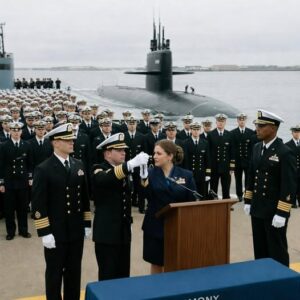
It swept across the flight deck in hard, slicing gusts, sharp enough to sting exposed skin and tug at uniforms like impatient hands. The sound of it filled the spaces where voices should have been. Five thousand sailors stood frozen across the USS Everett, lining catwalks, railings, hangar openings, and observation points in absolute silence.
No one spoke. No one shifted. Even the aircraft parked along the deck seemed to hold their breath.
At the center of it all stood Commander Madison Brooks.
Her boots were planted shoulder-width apart on the steel deck, posture locked into regulation perfection. Her jaw was set, lips pressed into a neutral line that betrayed nothing. She fixed her gaze just beyond the shoulder of the man facing her, eyes trained on an empty horizon as if the Pacific itself were the only witness she acknowledged.
But she felt every stare.
She felt the weight of thousands of eyes burning into her back, felt the judgment forming in the air like static before a strike. Fifteen years of service had taught her how to stand under pressure. This was different. This was not a mission brief or a hostile engagement. This was theater. Deliberate. Public. Final.
Admiral Richard Donovan stood opposite her, hands clasped behind his back, his presence radiating authority and fury in equal measure. The morning light caught the lines in his face, carving them deeper, harsher. His reputation preceded him across the fleet. Precise. Unforgiving. Devoted to protocol above all else.
When he spoke, his voice thundered through the ship via the 1MC system, amplified so that every sailor aboard would hear every word.
“Fifteen years of service mean nothing,” he declared, “when weighed against treason.”
The word dropped like a live round onto the deck.
Treason.
It rippled outward, sinking into the silence, infecting it. The accusation carried more weight than any physical blow ever could. Careers did not survive that word. Lives did not remain intact afterward.
Madison did not react.
She had trained herself not to. No flinch. No tightening of the jaw. No involuntary breath. She stood exactly as she had been taught, as she had taught others. Still. Composed. Untouchable.
“Permission to review the evidence, sir,” she said, voice calm, clear, steady.
“Denied.”
The response came without hesitation.
A subtle disturbance moved through the senior officers standing nearby. Barely visible. A tightening of shoulders. A glance exchanged. That was not procedure. Even in cases of extreme misconduct, an officer was entitled to review the evidence. This was not discipline.
This was an execution.
Donovan stepped forward, closing the distance between them. The wind snapped harder, whipping at Madison’s collar. She remained immobile, her peripheral vision catching the slight tremor in a junior officer’s hand nearby.
The admiral reached for her collar.
There was no ceremony. No formality. No measured removal.
His fingers closed around the silver oak leaf insignia she had earned through deployments that never made the news and decisions that kept people alive in places most sailors never saw. He ripped it free.
The sound of tearing fabric cut through the deck like a blade.
Madison felt it. Not the physical pull. The meaning of it. The violation. The erasure.
“Leave my ship,” Donovan said.
She saluted.
Not him. The uniform.
Then she turned and walked.
Her steps were precise, counted, every movement controlled as she crossed the flight deck toward the waiting helicopter. She did not look left. She did not look right. She did not allow herself to see the faces watching her pass.
But they saw her.
A young ensign stood in the shadow of the hangar bay doorway, pale, eyes wide. As Madison passed, he raised his hand in a crisp salute. It trembled, just slightly.
Another followed.
Then another.
Hands lifted across the ship. Quiet. Defiant. Respect offered where authority had stripped it away. Careers would pay for that moment later. Reprimands would be issued. Promotions delayed.
None of that mattered now.
Madison did not acknowledge the salutes. She could not. But something in her chest tightened anyway.
She climbed into the helicopter, secured the harness, and stared straight ahead as the rotors spun to life. The aircraft lifted, the deck shrinking beneath her, the carrier becoming just another shape cut into the ocean’s vastness.
The moment the ship slipped from view, she let herself breathe.
Her wrist brushed against bare skin where her watch used to sit. Muscle memory. Habit. And with it came the memories she never allowed herself to dwell on.
Heat. Sand. Static-filled radios.
“Shadow Protocol is active. Phantom is yours, Commander. Radio silence until mission complete.”
Three years.
Three years of building something no one was supposed to know existed. Not just commanding it. Designing it. Locking it behind safeguards she had written herself. A vessel that answered to one voice. One body. One rhythm.
Hers.
The helicopter touched down at Naval Base Kitsap far from the main traffic. No reception. No explanation. Two shore patrol officers escorted her into a windowless holding facility without speaking a word.
Concrete walls. Fluorescent lights. Silence.
To the world, it looked like disgrace.
Four hundred miles away, on the USS Everett, alarms shattered the calm.
“Admiral,” the tactical officer said sharply, “unidentified submarine contact. Nuclear class. Surfacing off our starboard bow.”
Donovan moved fast, anger already giving way to calculation.
“Identification.”
“None, sir. No response to hails. We’re receiving a text-only transmission.”
The main screen flickered.
Five lines of text appeared.
USS PHANTOM
Special Warfare Division
Awaiting orders from Commander Brooks
The room went dead quiet.
“There is no USS Phantom,” Donovan snapped.
A voice answered from behind him.
“Actually, sir,” Lieutenant Commander Jason Miller said evenly, “there is.”
And everything began to unravel.
The bridge of the Everett felt suddenly too small.
Consoles hummed, screens glowed, and yet no one moved. Five lines of text remained frozen on the main display, stark and undeniable. The word Phantom pulsed like a challenge.
“There is no USS Phantom,” Admiral Donovan repeated, louder this time, as if volume alone could erase what he was seeing. “Run the registry again. Pacific Fleet, Atlantic Fleet, special projects. Everything.”
“Yes, sir,” the operations officer replied, fingers flying, voice tight.
Lieutenant Commander Jason Miller didn’t move from his position near the plotting table. He stood with his arms crossed, face controlled, eyes steady. He looked like a man who had known this moment was coming and had spent months bracing for it.
“Admiral,” Miller said carefully, “with respect, you won’t find it in any registry you’re cleared to access.”
Donovan turned on him so fast the movement startled a junior officer nearby. “Explain yourself. Now.”
Miller inhaled once, slow and deliberate. “It’s Project Poseidon, sir. Special access. Compartmentalized beyond standard fleet command. Commander Brooks wasn’t just assigned to it. She built it.”
Captain Thomas Reed, the Everett’s commanding officer, stepped closer. “Built what, exactly?”
“A platform,” Miller said. “A capability. A deterrent. And a counter-intelligence net.” He gestured toward the screen. “That submarine out there isn’t malfunctioning. It’s behaving exactly as designed.”
Donovan’s jaw tightened. “You’re telling me a nuclear submarine is refusing to acknowledge my authority.”
“Yes, sir.”
“And you expect me to accept that?”
“I expect you to understand it,” Miller replied. “The Phantom’s command authentication is biometrically locked to Commander Brooks. Voice print, retinal scan, neural response timing, even typing cadence. The AI onboard doesn’t recognize rank. It recognizes her.”
The bridge fell silent again, but this time it was different. This time it was fear.
“Try again,” Donovan ordered sharply. “All frequencies. All codes. Emergency protocols. I don’t care what you use.”
The communications team complied instantly. Messages went out across encrypted channels, legacy systems, even Cold War-era backups that hadn’t been touched in decades.
Nothing came back.
The Phantom remained surfaced, black hull cutting cleanly through the water, motionless and patient. Its design was unlike any class Donovan had ever seen. Too sleek. Too quiet. Too wrong.
Hours passed.
Jets launched and circled. Destroyers repositioned. Sonar operators tracked every whisper of sound. Pentagon lines lit up, admirals demanded answers, analysts dug through layers of classification and found nothing they were allowed to see.
The Phantom waited.
At precisely 1400 hours, radar picked up an inbound aircraft.
Not a standard Seahawk. Not a routine transfer. A VIP bird.
Donovan’s stomach sank.
The helicopter touched down with surgical precision. When the door opened, the Chief of Naval Operations stepped onto the deck, his presence radiating authority that bent the air around him.
Admiral James Patterson did not look pleased.
Behind him came a man in a civilian suit with a forgettable face and eyes that missed nothing.
And then came Commander Madison Brooks.
Her uniform was immaculate. Her rank insignia restored. Her expression unreadable.
Donovan snapped to attention as if his body had decided before his mind caught up.
“Admiral Donovan,” Patterson said coolly. “Conference room. Now. Bring Captain Reed and Lieutenant Commander Miller.”
No one else was invited.
In the secure briefing room, doors sealed and soundproofing engaged, the truth finally surfaced.
The civilian introduced himself only as Carson.
“Project Poseidon,” he began, bringing up files that made even Patterson’s brow tighten, “was never about a submarine. It was about finding a leak.”
Images filled the screen. Financial trails. Surveillance stills. Encrypted messages. A web of compromise stretching across the Pacific theater.
“Commander Brooks’s so-called unauthorized communications,” Carson continued, “were sanctioned. We fed disinformation through channels we suspected were compromised. We needed confirmation.”
Madison spoke then, her voice level. “Four hours after I was relieved, Chinese intelligence received confirmation that their target had been neutralized. That confirmation traveled through the same channels that delivered the evidence to you.”
The screen changed.
A familiar face appeared.
Captain Daniel Harper.
Donovan felt the room tilt.
“Harper flagged Brooks,” Carson said. “Harper supplied the evidence. Harper was arrested three hours ago.”
Silence crushed the room.
“You used her as bait,” Donovan said hoarsely.
“We volunteered,” Madison corrected. “All of us.”
Patterson leaned forward. “Commander Brooks accepted public disgrace, professional annihilation, and the possibility of a court-martial to protect this fleet.”
Four sailors had died because of Harper’s leaks.
Four folded flags.
Donovan looked at Madison, really looked at her, and felt the weight of what he had done.
“I owe you—”
“You owe me nothing, sir,” she said. “You did exactly what you were supposed to do.”
Patterson stood. “You will reinstate Commander Brooks. Publicly. With full honors.”
“Yes, sir.”
Two hours later, the crew assembled again.
This time, the air felt different.
Admiral Donovan spoke into the 1MC, his voice steady but stripped of arrogance.
“Commander Madison Brooks was relieved as part of a classified counter-intelligence operation. She acted with extraordinary courage and selfless service.”
Then he did something no one expected.
He saluted her first.
Five thousand sailors followed.
And off the starboard bow, the ocean broke.
A black hull rose from the depths, water streaming down its sides.
USS Phantom.
Madison turned toward the helicopter, pausing beside Miller.
“I need an XO,” she said quietly.
“Yes, Commander.”
As the Phantom slipped beneath the waves once more, a message flashed across the Everett’s screens.
Command authentication confirmed.
Welcome back, Commander Brooks.
And far below the surface, the real mission resumed.
The flight deck vibrated as the helicopter lifted off, its rotors cutting clean arcs through the morning air. Sailors remained at attention long after the aircraft cleared the carrier, hands still raised, posture locked. No one spoke. No one needed to. The message had already settled into the steel bones of the ship.
Commander Madison Brooks was back.
The helicopter banked low over the water and approached the surfaced submarine. From the air, the Phantom looked even more unreal. Too smooth. Too deliberate. Its matte-black hull drank in the light, revealing nothing. As the pilot set the bird down on the small landing platform built into the sail, Madison felt a familiar calm slide into place. Not relief. Not triumph. Home.
She stepped out, boots striking the deck with solid certainty. The wind tugged at her coveralls, carrying the scent of salt and fuel. A hatch opened without a word spoken, mechanisms responding before she reached it. The Phantom recognized her presence the way a living thing recognizes its own.
Inside, the lighting shifted to red. The air was cool and dry, the hum of systems steady and reassuring. Crew members stood at their stations, faces composed, eyes forward. They had heard everything. The disgrace. The silence. The waiting. They did not cheer. They did not smile.
They trusted.
“Commander on deck,” a voice called.
“At ease,” Madison said, her tone familiar, grounding.
She moved through the control room, fingertips brushing the edge of the command chair. Three years of planning. Three years of restraint. Three years of knowing that this moment would come only if everything went exactly as it had.
Lieutenant Commander Miller stepped into position beside her, seabag already stowed, posture crisp but eyes alive with focus.
“Navigation green,” he reported. “Reactor steady. Weapons secure. AI core synced.”
Madison nodded once and settled into the chair.
“Take us deep,” she said. “Silent running. Course for Station Alpha.”
“Aye, Commander.”
The Phantom slid beneath the surface with barely a ripple, the ocean closing over it as if it had never been there at all.
Above, on the USS Everett, Admiral Donovan stood at the rail, watching the last disturbance fade into smooth water. The carrier resumed its rhythm. Aircraft launched. Orders flowed. But something fundamental had shifted. A lesson had been written into the ship’s memory.
Captain Reed joined him, quiet for a long moment.
“Sir,” he said finally, “what exactly is that submarine capable of?”
Donovan did not answer right away. He watched the horizon, the place where certainty ended and responsibility began.
“I don’t know,” he said at last. “And that’s probably the point.”
Three hundred feet below, the Phantom leveled off beyond depths where most boats dared to travel. Sonar faded into background noise. Pressure pressed in, constant and immense, but the hull did not complain. It had been built for this. Like its commander.
Madison leaned back slightly, listening to the quiet. Not the absence of sound, but the presence of control. She thought of the flight deck. The tearing fabric. The word treason hurled like a weapon. The salutes that followed anyway.
Some missions required sacrifice. Some victories demanded that you lose first. And some officers understood that the highest form of service was not recognition, but trust.
A console chimed softly.
“Commander,” Miller said, “we are approaching the boundary.”
Madison’s lips curved into the smallest hint of a smile.
“Proceed,” she said. “Phase Two.”
The Phantom descended deeper, into places maps did not show and records would never mention. Somewhere far above, flags flew, reports were filed, and official histories remained clean and uncomplicated.
Down here, in the dark, the real work began.
And the ocean swallowed them whole.