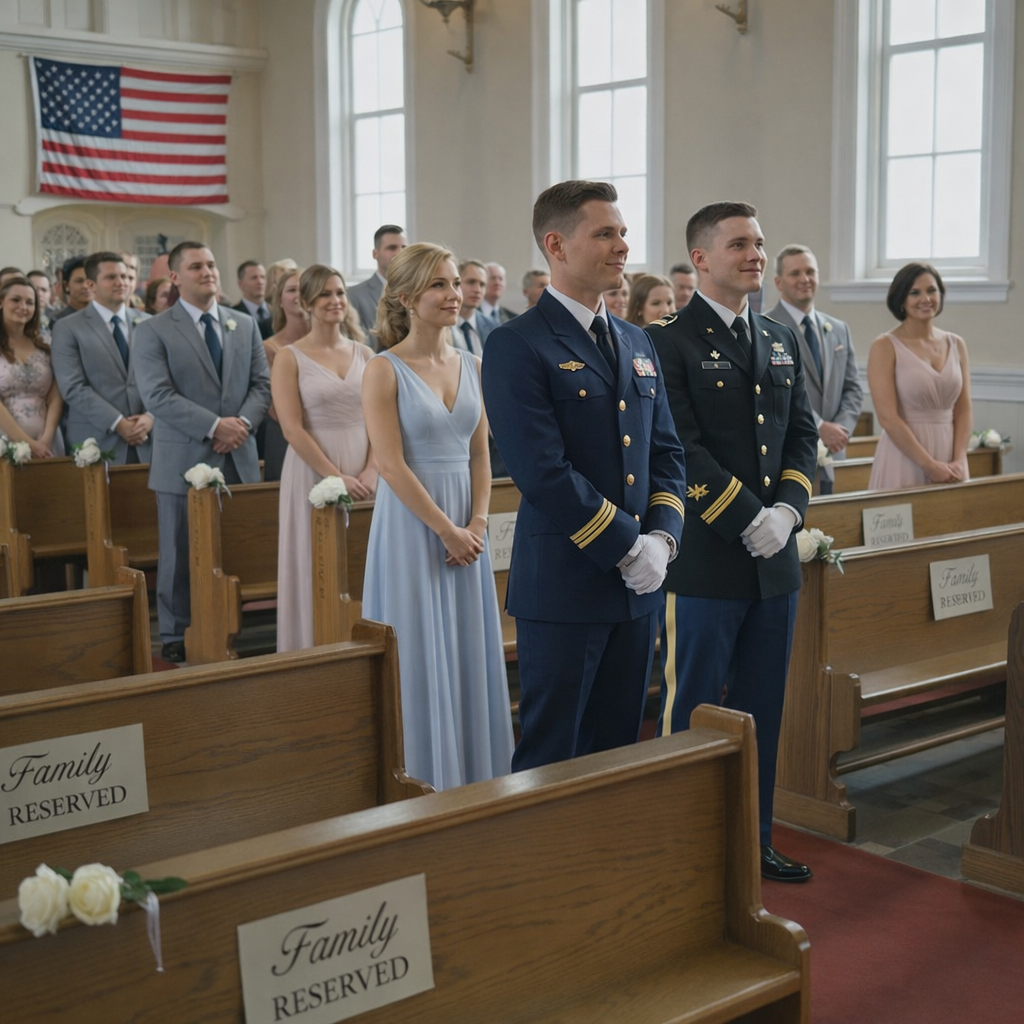
I have been trained to hold a steady expression while chaos unfolds.
It is one of the strange gifts the Navy gives you. You learn to keep your voice level while alarms are sounding. You learn to make decisions while your body is begging for sleep. You learn to read a room quickly, to spot the person about to fold, to offer them a lifeline without making it a spectacle. You learn that composure is not the absence of feeling. It is the discipline to carry feeling without letting it steer the ship.
For eight years, I wore the uniform my family never learned how to respect.
They respected clean success, the kind you can explain at a dinner party without an awkward pause. They respected jobs that came with titles people recognized and stories that could be told over cocktails without drifting into uncomfortable territory like war, sacrifice, or duty. They respected my sister’s glossy career progress and my father’s predictable prestige. They respected the kind of work that looked good in photographs.
The Navy was not photogenic to them. It was something you thanked people for, something you praised at a distance, something you referenced in a patriotic sentence and then changed the subject.
And I kept showing up anyway.
I showed up for birthdays that weren’t really mine. I showed up for holidays where my achievements were quietly placed beside the salt shaker and forgotten. I showed up for my mother’s charity luncheons and my father’s work events, smiling politely while strangers asked what I did and my mother answered for me in language that made my job sound smaller, safer, easier to digest.
I answered dismissive comments with grace because I was good at that. I practiced grace like a muscle. I made it a habit. I told myself that one day, if I stayed steady long enough, they would have to see me.
They never did.
The moment something finally broke free in me was not a fight. It was not a scream. It was not an argument that ended with slammed doors. It was my parents and my sister boarding a flight to London during the week of my engagement ceremony and posting champagne photos with a caption that felt like it had been written specifically to bruise.
Some celebrations actually matter.
The words sat on my screen like a verdict. Like a stamp. Like a label that had always been there, invisible until someone finally made it readable.
I want to be clear about what this story is and what it is not.
It is not a revenge story. I did not scheme. I did not plan some elaborate punishment. I did not stand in a room and humiliate them in front of an audience the way they humiliated me with that caption.
It is a story about reality settling in.
It is about realizing who shows up when it counts.
And it is about what happened when my family saw my wedding, not from a seat in the front row, but on the evening news.
The first cracks appeared long before I ever put on a wedding dress.
They started with small comments, the kind that pass as jokes if you don’t examine them too closely. The kind that sting like paper cuts because they are delivered with smiles, and you are expected to laugh or you become the problem.
My sister Lydia has always been beautiful in an effortless, curated way. She learned early how to use it. She understood, instinctively, what people wanted to hear. She could enter a room and make it tilt toward her without raising her voice.
At family dinners, when conversation lulled, she’d pick up her wine glass and glance at me as if she were about to offer a compliment. Then she’d say, lightly, “Elena will probably marry some sergeant with a jeep,” and laugh, waiting for everyone else to laugh too.
My mother, Caroline, would smile with the careful restraint of someone who doesn’t approve of crudity but doesn’t mind cruelty as long as it is packaged politely. My father, Richard, would chuckle if he was in a good mood, or pretend he didn’t hear it if he wasn’t.
I learned to smile. I learned to tilt my head and answer with a calm line that made it seem like it didn’t bother me. I learned to swallow humiliation like it was a necessary vitamin.
When I wore my uniform to one of my mother’s dinner parties, she met me in the hallway before guests arrived, hands already reaching for my shoulders like I was a mannequin she could adjust.
“Your posture,” she murmured, lowering her voice. “It’s very… intense.”
“It’s called standing up,” I said, trying to keep it playful.
She smiled tightly. “Just try to look less rigid. Less military. You know how people are.”
People. That word. The faceless group she always used to justify whatever embarrassment she felt. As if my service was not something to be proud of, but something that needed to be softened so it wouldn’t disturb the aesthetic of her evening.
They never said outright that they were embarrassed by my career. They didn’t need to. They communicated it through what they celebrated.
What mattered in our house was that Lydia had just been promoted to senior marketing director at a tech firm. My mother could say those words to her book club friends and watch their eyes brighten with recognition. She could talk about brand strategy and client wins. She could post polished photos at company events and tag Lydia in them, collecting compliments like coins.
My father measured success in billable hours and client retention. Corporate law made sense to him. It had structure. It had prestige. It had predictable markers of advancement.
My work was harder to translate. It was not dinner party friendly. It was difficult to compress into a single sentence without sounding dramatic or vague.
I served on three deployments. I earned commendations for tactical analysis. I briefed admirals, managed classified intelligence operations, and led teams through complex strategic challenges that required you to keep your mind clear even when your body screamed for rest.
At family dinners, none of that registered.
Conversation always drifted back to Lydia’s latest campaign, the new condo she was considering, the clients she was “closing.” My father talked about his cases, the big ones that had everyone at his firm buzzing. When I spoke, it was like throwing a pebble into a river. The water moved past it without change.
I learned to stop talking about my work. When they asked what I did, I kept it vague.
“Communications,” I’d say. “Intelligence analysis. It’s fine.”
Fine. As if it was a desk job I tolerated, not the work I built myself into.
It was easier to pretend it was nothing than to watch them dismiss it again.
When I got engaged, their reaction was muted enough that it took me a second to recognize disappointment hiding inside politeness.
My mother smiled and said, “That’s lovely, dear,” in the tone she used when someone announced a new haircut. My father nodded and shook Mark’s hand, but it was the kind of handshake that felt like an evaluation rather than a welcome.
Lydia looked at the ring and said, “Nice,” then asked where it was from, as if the brand mattered more than the promise.
I caught my father whispering to my mother later that night. He didn’t know I was walking down the hall toward the kitchen. He didn’t know the house was quiet enough for his words to travel.
“She’s always been desperate to prove something,” he murmured.
My mother made a small sound of agreement, the kind of hum that implies, yes, obviously.
I paused in the hallway, my hand on the wall, and felt something tighten inside my chest. Not anger. Not yet. Something more familiar. That old ache of being misunderstood and still trying anyway.
I didn’t tell them much about Mark because they never asked.
He was “someone I met through work,” which was technically true. We met in a professional setting, two officers in the same orbit. But I didn’t tell them his rank or the scale of his responsibilities. I didn’t mention the rooms he walked into, the people who listened when he spoke. I didn’t mention that his work involved briefing members of Congress and the Joint Chiefs of Staff, or that his reputation was the kind that followed him.
I didn’t mention it for two reasons.
First, it didn’t matter to me. I loved him because of who he was when it was just us. I loved him because he listened, because he noticed, because he respected me without trying to reshape me.
Second, I knew it wouldn’t matter to them in the way it should. They had already decided who I was: the daughter who chose the wrong kind of life. They weren’t interested in learning details that might force them to reconsider.
Then Lydia announced the London trip.
It happened over brunch, as casually as if she were telling us about a new restaurant she wanted to try. She had her phone out, scrolling through flights, eyes bright.
“Mom and Dad and I are finally doing it,” she said. “London. It’s happening.”
My mother’s face lit up with genuine excitement. My father leaned in, interested. I watched them soften in a way I rarely saw when they talked to me.
“What week?” my father asked.
Lydia named the dates.
The dates of my engagement ceremony.
Not the wedding itself. The engagement ceremony required by our command, the one where paperwork was signed, where my commanding officer would speak, where we would stand in formal dress uniform and make it official in front of the people who actually lived our lives with us.
I waited for someone to notice. I waited for my mother’s face to shift, for my father to blink, for Lydia to pause and say, oh, right, we’ll adjust.
Nothing.
I cleared my throat. “That’s the week of my engagement ceremony.”
Lydia looked up with a smile that didn’t reach her eyes. “Yeah. We know.”
My stomach tightened. “Why that week?”
She swirled her mimosa, her tone smooth. “It’s the week that worked for everyone.”
“Except me,” I said quietly.
She tilted her head. “Elena, you’ll have plenty of ceremonies. You always do.”
My mother looked away. My father cleared his throat and started talking about airline miles.
And then Lydia said it, like she was delivering a punch wrapped in silk.
“To celebrate something worthwhile.”
The words hung in the air, thin and poisonous.
My face stayed neutral. My voice stayed steady.
Years in the military teach you how to compartmentalize. You learn to file feelings away until you can deal with them later. You learn to function even when something inside you is bleeding.
So I didn’t argue. I didn’t beg. I didn’t ask them to reconsider.
I just said, “Have a good trip,” and went back to planning an event they had made clear they didn’t care about.
Mark noticed.
He always notices.
We were at the kitchen table one evening, reviewing a guest list I had tried to keep modest. My pen hovered over names. I had printed cards with clean fonts, created seating plans out of habit.
He set down his pen and looked at me directly.
“They’re really not coming.”
It wasn’t a question. He wasn’t asking for confirmation. He was acknowledging what he already understood.
“They’re really not coming,” I said.
He studied me for a moment, eyes steady. “Is it because they don’t approve of the military,” he asked, “or because they don’t approve of you?”
The question landed gently, but it hit deep.
I sat back in my chair, feeling the weight of trying to explain something that had shaped me for years. “I think they’re embarrassed,” I said slowly. “The military was supposed to be a phase. I was supposed to grow out of it. Instead, I made it my life.”
He nodded as if he were reading a report. “Their loss.”
I wanted to believe that sentence could dissolve the ache. I wanted to believe that love from the right person could make lack of love from the wrong people irrelevant.
Sometimes it can. Sometimes it can’t, not immediately.
I tried not to think about it after that conversation. I focused on work. On ceremony details. On making sure the paperwork would be correct, the flags folded precisely, the protocol followed.
I told myself it didn’t matter. I told myself I had built a life outside their approval. I told myself my chosen family would fill the spaces they left empty.
But the night before the engagement ceremony, I sat alone in my quarters and stared at three empty RSVP cards I had printed for them. I ran my thumb along the edge of one card, feeling the texture of the paper, and imagined three chairs in the front row with small signs that said family of the bride.
Empty.
I thought about throwing the cards away. I thought about pretending they hadn’t been invited, pretending the absence wasn’t real.
Something stubborn in me wouldn’t let go.
I wanted the empty seats visible. I wanted the truth to take up space.
The engagement ceremony was modest but formal, the way military events often are. Nothing extravagant, but everything intentional.
Folded flags on the tables. A simple arrangement of flowers that smelled faintly green and clean. Navy blue uniforms, pressed sharp enough to cut. Ribbons and medals catching the afternoon light.
My commanding officer, Colonel James Harper, stood near the front, speaking quietly with other senior officers. He had the kind of calm authority that makes a room align itself around him.
Senior officers attended, people who had supervised me, evaluated me, pushed me hard because they believed I could take it. People who had seen me exhausted and still steady, angry and still disciplined, frightened and still functional.
My friends showed up too, the people who knew me beyond titles.
Lieutenant Commander Sarah Chin, my roommate during officer training, her hair pulled back in the same tight style she always wore when she was emotional and didn’t want anyone to see. Petty Officer First Class Mike Rodriguez, whose easy grin never quite hid the seriousness behind his eyes. Commander Patricia Oay, who had mentored me through my first deployment, her presence steady as an anchor.
These were my people.
They understood what it meant to serve. They understood sacrifice. They understood showing up.
Colonel Harper pulled me aside before the ceremony began. His voice was careful, his eyes reading my face. “Your family couldn’t make it.”
“They had other plans,” I said, my tone neutral.
He held my gaze for a moment, then nodded once, not pitying, just understanding. “Their loss. Hall’s a solid officer. You two are going to do good work together.”
The ceremony proceeded with precision. Mark stood beside me in dress uniform, his posture relaxed in a way that still radiated control. When he slipped the ring onto my finger, I felt something settle in my chest.
Not happiness exactly.
Certainty.
This is real, my body seemed to say. This is what showing up looks like.
But the empty seats still filled the room like smoke. People noticed. A few asked quietly where my family was. I gave them the same answer each time.
“They had other plans.”
No one pushed. Military people understand loyalty, but they also understand when loyalty isn’t returned. They know the look in someone’s eyes when a subject is a bruise.
That night, after the ceremony, I checked my phone out of habit.
Lydia had posted photos from London.
Champagne glasses clinking against the Thames. A rooftop dinner overlooking city lights. Lydia’s arm around my mother, both of them laughing into the camera as if nothing else existed. My father in the background, smiling in a way I rarely saw when he looked at me.
The caption read: Some celebrations actually matter. ✨
I stared at those words until my eyes burned. I read them over and over, as if repetition might change them into something less cruel.
They didn’t.
I set my phone face down on the nightstand and lay in bed staring at the ceiling. The room was quiet except for the distant hum of the building. My body felt heavy, like fatigue had finally caught up with me.
I told myself I wouldn’t cry over them.
I cried anyway, silently, because crying is sometimes the body’s way of releasing pressure you’ve been holding too long.
By morning, the photo was everywhere. Someone tagged me. Someone else shared it. By noon, half my unit had seen it.
By evening, Mark saw it too.
He didn’t explode. He didn’t rant. He didn’t even swear.
He looked at the screen, then at me, then back at the screen. He set the phone down carefully, as if it were something fragile.
“Now I understand,” he said quietly.
“Understand what?” My voice sounded smaller than I wanted.
“Why you never talk about them. Why you flinch every time someone mentions family leave.” He reached across the table and took my hand. His grip was gentle. “They don’t see you, do they?”
I wanted to defend them out of reflex. I wanted to say they mean well, they’re complicated, they don’t understand this world. I wanted to offer excuses the way I always had.
I was too tired.
“No,” I said. “They don’t.”
He was quiet for a moment. “Then do you still want to do this quietly?” he asked. “The wedding.”
I had told him I wanted something small and private. Just us, a handful of witnesses at the base chapel. No spectacle. No drama. No begging anyone to care.
“Yes,” I said firmly. “I don’t need a big production.”
He nodded. But something in his expression shifted, a flicker of determination mixed with protective anger.
“Okay,” he said. “Small and private.”
I believed him.
I should have known that Mark doesn’t lie, but he does interpret.
His definition of small is not the same as most people’s.
To understand why the London post cracked something open so completely, you need to understand the history, not as a list of events but as a pattern.
I grew up in a house where appearances were currency.
My mother hosted charity luncheons and served on museum boards. She could glide through a room balancing a glass of white wine and a conversation about philanthropy. She used the phrase “optics” like it was a moral principle.
My father measured his worth in billable hours and professional influence. He enjoyed being needed by clients who called him in crisis. He liked the feeling of being important.
Lydia fit them perfectly.
She did beauty pageants at sixteen. She earned academic scholarships at eighteen. She climbed corporate ladders with a kind of polished ease that made my mother glow with pride. Lydia’s achievements were visible. They were easy to package. They made my family look good.
I was none of those things.
I was the kid who took apart radios to see how they worked. The teenager who joined Junior ROTC because I craved structure and purpose. The college student who shocked everyone by enlisting instead of finishing my electrical engineering degree.
When I told my parents I was joining the Navy, my mother cried as if I’d announced I was throwing my life away. My father sat in silence for three full minutes before saying, “You’ll grow out of this phase.”
I didn’t grow out of it.
I grew into it.
Boot camp was brutal, but it was also clarifying. For the first time in my life, my worth wasn’t tied to being charming or pretty or easy to explain. My worth was tied to competence. To showing up. To completing the mission. To having your shipmates’ backs.
I could do that.
The first time I came home in uniform, my mother asked me to change before dinner guests arrived. “You know how Barbara is about politics,” she said, as if my service was a political statement instead of a career.
I changed.
I told myself it was about keeping the peace.
Over the years, I earned promotions. I completed deployments. I received commendations. I built a reputation for staying calm under pressure. I became someone people trusted with difficult work.
My family never came to a single ceremony.
Not my commissioning. Not my promotions. Not my commendation presentations. I would send details. My mother would respond with a polite text about scheduling conflicts. My father would mention a deposition. Lydia would be at a conference.
I kept inviting them anyway. Loyalty runs deep when you are raised to earn love through performance. I kept thinking the next achievement would be the one that finally mattered.
It never was.
Lydia’s milestones were celebrated with expensive dinners and champagne. My mother posted photos of Lydia with captions like “So proud of our brilliant daughter,” and the word daughter always seemed singular, even if she didn’t mean it that way.
I stopped bringing up my work around them. When they asked what I did, I kept it vague.
It wasn’t boring. It was complex and high-stakes and sometimes exhausting in ways that seeped into your bones.
But they didn’t want to hear about it, and I was tired of performing for an audience that had already left the theater.
Then I met Mark.
We met at a joint service conference on cybersecurity threats. I was presenting on signal intelligence protocols. Mark was three rows back, asking questions that told me he wasn’t just polite. He understood the material.
Afterward, he introduced himself.
“Commander Hall,” he said. “That was solid work you presented, Captain Ward.”
“Thank you, sir,” I replied automatically.
He smiled. “We’re the same rank, Captain. No need for the sir.”
That was the first sign he was different. He didn’t lead with ego. He didn’t need to dominate. He wasn’t trying to prove he was the smartest person in the room.
We started talking, first about work, then about everything else. There was an ease to it that surprised me, a feeling of being met instead of evaluated.
He told me he grew up in Montana, enlisted right out of high school, and worked his way up through competence and discipline. He had deployed seven times. He had earned a battlefield promotion. He had gone back to school while serving full-time, stacking degrees without ever making it sound impressive.
He never bragged. He stated facts when asked, like reporting weather.
I didn’t know at first that his work sat at a high level of defense intelligence. I didn’t know his clearance was several levels above mine or that he briefed people whose names showed up in headlines. He never made it the centerpiece of who he was.
We met as equals.
For the first time in my adult life, I wasn’t the disappointment. I wasn’t the daughter who chose wrong. I was just Elena.
And that was enough.
Six months into our relationship, we were at a quiet restaurant off base, the kind with low lighting and soft music that makes conversation feel private even when there are other people nearby. We had been talking about families.
His were supportive but distant, living their own lives in rural Montana. Mine were complicated in a way that made my throat tighten even when I tried to describe it casually.
“They’ve never come to a ceremony?” he asked, genuine disbelief in his voice. “Not once? Not even your commissioning?”
“My mother had a migraine,” I said. “My father had a deposition. Lydia was at a conference.”
Mark went quiet. He turned his water glass slowly, the motion controlled, thoughtful.
“You deserve better than that,” he said.
The sentence cracked something in me. It was so simple, so direct, and it made my eyes sting. I looked away quickly, blinking hard.
“I’m used to it,” I said, like that made it acceptable.
“That doesn’t make it okay.” He reached across the table and took my hand. “You deserve people who show up.”
I didn’t realize until then how much I had accepted absence as normal.
Three months later, he proposed during a weekend trip to Annapolis. We walked along the waterfront near the Naval Academy, the air smelling like salt and cold water, the sky pale. He stopped at a bench overlooking the bay and pulled a small box from his jacket pocket.
“I’m not good at speeches,” he said. “But I know what I want. I want to build a life with someone who understands service and duty. Someone who shows up. Someone who doesn’t quit when things get hard.” He opened the box. “I want to build that life with you.”
The ring was simple. White gold. One diamond. Elegant and understated, exactly right.
“Yes,” I said without hesitation. “Absolutely yes.”
When I called my parents, my mother’s response was lukewarm.
“Oh, well, that’s nice, dear,” she said. “What does he do?”
“He’s in the military, like me.”
“Oh.” A pause heavy with disappointment. “Well, I’m sure you’ll be very happy.”
That was it.
Lydia’s text was worse.
Congrats. Is he active duty? Hope you know what you’re getting into lol.
As if I were naive. As if I hadn’t spent eight years living this life already.
After London, something in me shifted, like finally seeing the blueprint of a house you’ve lived in for years and realizing the foundation has been cracked the entire time.
I didn’t call them demanding explanations. I didn’t write long messages about how hurt I was. I sat in my quarters the night after the engagement ceremony, stared at their London photo, and realized I had been fighting a one-sided war for years.
Every achievement, every pressed uniform, every commendation I had hoped they might ask about was a silent plea for validation.
They left the country to make a point.
Some celebrations actually matter.
That caption wasn’t careless. Lydia wrote it knowing I’d see it, knowing people I worked with would see it. It was a public statement about my worth.
Lieutenant Commander Chin knocked on my door that evening and let herself in when I didn’t answer fast enough.
“You doing okay, Ward?”
“I’m fine.”
She sat on the edge of my desk, arms crossed. “That’s not what I asked.”
Chin had earned the right to push. We’d known each other since officer candidate school. We’d deployed together. We’d covered for each other during inspections, crises, and the occasional bad day where the only thing keeping you upright is the fact that someone else is watching your back.
“That photo was cruel,” she said bluntly.
“It was honest,” I said.
“Cruelty and honesty aren’t the same thing.” She leaned forward. “You know you didn’t deserve that, right?”
I wanted to agree. I wanted to feel righteous anger. Mostly, I felt tired.
“It doesn’t matter,” I said. “The ceremony happened. Mark and I are engaged. Whether they were there doesn’t change that.”
Chin looked at me for a long moment, her eyes softening. “Except it does,” she said quietly. “Because you’re sitting here alone instead of celebrating with your fiancé.”
She was right.
The next morning, I met Mark for breakfast at the base commissary. He was already there, reading through briefings on a tablet, his posture relaxed but alert.
“Morning,” he said. “Sleep okay?”
“Well enough.” I sat down, staring at my coffee. “We need to talk about the guest list.”
He set down the tablet. “Okay.”
“Your aide mentioned the Secretary of Defense confirmed attendance.”
Mark blinked, genuinely surprised. “I told her to send regrets on my behalf. He doesn’t need to spend his time at a junior officer’s wedding.”
I stared at him. “Mark. What is your actual rank?”
His expression shifted, almost amused. “Major General,” he said simply. “Though I expect to make Lieutenant General next promotion cycle if the board goes well.”
I blinked, my brain catching up.
Major General. Two stars.
That explained the security. The guest list. The attention.
“Why didn’t you tell me?” I asked.
“Would it have mattered?” he replied, not defensive, just curious.
I thought about it. “No,” I admitted. “But it explains a lot.”
He nodded. “I can make calls,” he offered. “Keep it small if that’s what you want.”
I thought about the empty chairs. I thought about London. I thought about the way my family only looked up when something could be turned into status.
“No,” I said slowly, feeling resolve build. “Don’t make calls. Let them come. Let’s do this properly.”
“You sure?”
“I’m sure.”
He studied my face for a moment, then nodded. “All right. But this is still about us, Elena. Not about proving anything to them.”
“I know,” I said, and I meant it.
Wedding planning became something else entirely.
I expected simple logistics: book the chapel, arrange flowers, choose music. Instead, I found myself coordinating with Mark’s aide, Lieutenant Colonel Patricia Vasquez, a sharp woman who approached wedding planning like a military operation.
“Captain Ward,” she said in our first meeting, “I need to confirm details for security clearances.”
“Security clearances,” I repeated.
“When you’re marrying a two-star general who works in strategic operations,” she said, “yes, ma’am.”
“How many people are we talking about?”
She pulled up a spreadsheet. “Seventy-three confirmed, twenty-two pending. Forty-one require enhanced protocols.”
Seventy-three.
My idea of small had been twenty.
Mark’s definition of small was under one hundred.
Two weeks before the wedding, Chin walked into my office holding out her phone.
“You need to see this.”
It was Lydia’s Instagram story. A screenshot of a news article with the headline: Pentagon General to Wed Fellow Naval Officer in Private Ceremony.
The article noted Mark’s position and mentioned that several high-ranking officials would attend. It listed my service record in a few lines, enough to make it sound neat and impressive.
Lydia’s caption read: Wait, is this my sister Elena? Why didn’t anyone tell me she was marrying a GENERAL??
I stared at it, feeling something strange in my chest. Not shock. Not anger. More like confirmation.
Below the story, comments from extended family members I hadn’t spoken to in years.
Tell her congratulations!
Why weren’t you invited?
We need details!
Suddenly, everyone cared.
My phone started buzzing. Calls. Texts. Voicemails. My mother, my father, Lydia.
Why didn’t you tell us?
We need to talk about the wedding.
We’d like to be there.
By evening, I had dozens of missed calls.
My mother left a voicemail that began, “Elena, sweetheart, I don’t understand why you’ve been shutting us out,” and ended with her crying about how they’d “always supported my choices.”
Always supported my choices.
I remembered her asking me to change out of my uniform. I remembered the empty ceremonies. I remembered London.
I set my phone face down and went back to work.
Mark called later. “They know,” I said.
“Do you want them there?” he asked.
I stared at the wall, thinking carefully. “Part of me wants to say yes because they’re my family,” I admitted. “Part of me knows they only care because it’s suddenly impressive.”
“What did you tell them?”
“Nothing yet.”
“This is your call,” he said. “If you want them there, I’ll make it happen. If you don’t, that’s okay. But decide based on what you want, not what you think you owe.”
The next morning, Lydia posted a photo at brunch with my parents, all dressed up and smiling.
Family meeting about some very exciting news! So proud of my little sister ❤️ Can’t wait to celebrate with her #proudfamily #militarywedding
Proud family. After some celebrations actually matter.
I screenshot it and sent it to Mark with one line: This is who they are.
Understood, he replied. Your call.
I sat with that, then sent a message to my mother, father, and Lydia together:
I appreciate your interest in the wedding. Unfortunately, the security clearance process for guests closed last week and we can’t add anyone new to the approved list at this late stage. Perhaps we can get together afterward.
Professional. Polite. Final.
I hit send before I could second-guess myself.
The responses came fast.
My mother: That’s ridiculous. We’re your parents.
My father: This is unacceptable. We will be there.
Lydia: Are you serious? Everyone’s asking about this.
I set my phone to Do Not Disturb.
Chin stopped by later. “Did you tell them?”
“I told them the guest list is closed.”
She grinned. “Good.”
“Is it good?” I asked, the doubt creeping in. “Am I setting boundaries or being vindictive?”
“You’re protecting your peace,” Chin said. “There’s a difference.”
The wedding day arrived cold and clear, the kind of day where the air feels sharp in your lungs.
The base chapel at Fort Meyer sits on a hill overlooking Arlington National Cemetery, a modest building that has hosted thousands of military weddings. White stone, tall windows, a quiet kind of dignity.
As our car pulled up, I saw the security perimeter immediately.
Military police at entrances. Black SUVs with tinted windows. A Secret Service agent speaking into his wrist.
Chin, riding with me, muttered, “How many VIPs are in there?”
Through the open chapel door, I caught a glimpse of uniforms filling the pews. Navy dress whites and blues. Army service uniforms. Marine Corps dress blues. Air Force service dress. Medals catching the light. Brass buttons gleaming.
I recognized faces as we walked toward the bride’s room.
Admiral Richardson. Brigadier General Santos. Major General Patricia Coleman.
These were people who shaped policy. People whose decisions rippled outward.
My family wasn’t there.
Colonel Harper appeared before the ceremony, his expression steady. “How are you holding up?”
“Overwhelmed,” I admitted.
He smiled slightly. “Your family isn’t here.”
“No, sir.”
He studied me for a moment. “The people out there,” he said, “they’re your family too. Maybe not by blood, but by choice. That counts.”
He straightened. “General Hall asked if I would walk you down the aisle. I told him yes, but only if you’re comfortable.”
I looked at him, this man who mentored me, who fought for my promotions, who showed up when my own father didn’t.
“I’d be honored,” I said.
The music began. The doors opened.
The entire chapel stood, every single person, from the Secretary of Defense in the front row to junior enlisted sailors in the back, standing at attention as I entered.
I kept my eyes forward, focusing on Mark at the altar, his face calm, his gaze fixed on me like I was the only thing that mattered.
Colonel Harper walked me down the aisle with precision. When we reached the altar, he placed my hand in Mark’s and stepped back.
Mark squeezed my hand gently. “You okay?”
“Getting there,” I whispered.
The chaplain began. The ceremony moved smoothly, words familiar and solemn.
When it came time for vows, Mark spoke first.
“Elena,” he said, voice clear, “I promise to stand beside you in every deployment, every challenge, every quiet moment and crisis. I promise to see you clearly, to value your service, and to build a partnership based on mutual respect. I choose you today and every day forward.”
My throat tightened.
When it was my turn, my voice held steady.
“Mark,” I said, “I promise to meet you as an equal, to trust your judgment, and to build a life together that honors both our service and our commitment. I promise to show up always, the way you’ve shown up for me. I choose you today and every day forward.”
The chaplain smiled. “By the power vested in me, I now pronounce you married. General Hall, you may kiss your bride.”
Applause erupted as we walked back down the aisle, husband and wife.
Outside, photographers swarmed. Military press. A few civilian reporters granted access because of Mark’s position.
Mark kept his hand on my back, steady and protective.
“How are you doing?” he asked.
“I just married a two-star general in front of the Secretary of Defense,” I said, a breathless laugh escaping me.
“You just married me,” he corrected. “The rest is context.”
The reception was warm and elegant, filled with toasts from people who had actually invested in our lives. Secretary of Defense Alan Rhodes approached us to congratulate us. Admiral Richardson gave a speech about partnership in service. Colonel Harper raised a glass to “two excellent officers building something real.”
That night, in the quiet of the hotel room, I turned my phone back on.
It exploded.
Calls. Texts. Voicemails.
My mother: Elena, we saw the news. Please call us.
My father: This is unacceptable. You should have told us who he was.
Lydia: You got married to a Pentagon general and didn’t invite your own family? What is wrong with you?
Not one congratulations.
Not one apology.
I scrolled until I found Lydia’s final message:
Everyone’s asking why we weren’t there. This is humiliating. You’ve made us look terrible. How could you be so selfish?
Selfish.
The word landed like a familiar slap.
I started blocking numbers.
My mother. Blocked.
My father. Blocked.
Lydia. Blocked.
Extended family who suddenly remembered I existed. Blocked.
Mark found me crying into his uniform shirt, the fabric smelling faintly like clean starch and the day’s cold air.
“I blocked them,” I said. “All of them.”
He pulled me close. “You dealt with a threat the way you deal with any threat,” he said quietly. “You neutralized it. That takes strength.”
For months afterward, they tried everything.
Emails to my work address. Messages through distant relatives. Letters from my father that I returned unopened.
My mother even tried calling Mark’s office directly, but Lieutenant Colonel Vasquez handled it with professional efficiency.
Lydia tried social media, posting childhood photos with captions like I miss my sister and family should stick together, fishing for sympathy from people who didn’t know the whole story.
I didn’t respond.
In the military, silence can be a weapon. It can also be a shield. They wanted engagement, wanted me to defend myself, wanted a conversation where they could reshape the narrative.
I refused to give it to them.
Three months after the wedding, I was promoted to commander. The ceremony was held at the Pentagon.
Colonel Harper was there. Chin. Oay. Rodriguez. Colleagues who had supported me for years.
My birth family wasn’t there. I didn’t invite them.
After the ceremony, Admiral Richardson pulled me aside. “Commander Hall,” he said, “your work has been exceptional. You’re on the short list for significant assignments.”
He paused. “I also want to say, I know your family situation has been difficult. I saw who was absent from your wedding. For what it’s worth, you handled that with more grace than many officers would have.”
“I had good examples,” I said.
He studied me. “You had good instincts. Don’t undervalue that.”
That night, Mark made dinner badly while I sat at the counter watching him struggle with pasta.
“Congratulations, Commander,” he said, grinning when the noodles threatened to escape the pot. “I’m proud of you.”
“You say that a lot,” I teased, the warmth in my chest surprising me.
“Because it’s true a lot,” he said. He pulled me into a hug. “You earned everything you’ve achieved.”
The next morning, a letter arrived from my mother. Three pages on expensive stationery, carefully worded, full of apologies that never quite reached accountability.
The final paragraph told the truth beneath the performance.
Several of my friends have asked why we weren’t at your wedding. It’s been very difficult. People are starting to talk.
Not: We hurt you.
Not: We were wrong.
Not: We missed something important.
It was about optics.
I read it twice and threw it away.
Six months later, Lydia sent a message through LinkedIn.
Elena, I know you’ve blocked me everywhere else. We didn’t know who he was. We thought you were rushing. We made a mistake. Can we talk?
We didn’t know who he was.
That was the confession in the middle of her plea. The admission that they would have cared if they’d known Mark’s rank. They would have shown up if there had been prestige attached.
They still didn’t see me.
They saw status.
I closed LinkedIn without responding.
That night, Mark and I had dinner with Colonel Harper and his wife Margaret at their home in Alexandria. Their dining room smelled like roasted garlic and something sweet baking in the oven. The warmth felt different from my childhood home. Less polished. More real.
Over dessert, Margaret asked gently, “Have you heard from your family?”
“Occasionally,” I said. “They reach out through different channels. I don’t respond.”
“That must be hard,” she said.
“It was at first,” I admitted. “Now it’s routine maintenance. Like any boundary.”
Colonel Harper set down his coffee cup. “My father told me when I first enlisted that you’ll build two families,” he said. “The one you’re born into and the one you choose through service. Sometimes they overlap, sometimes they don’t. The important thing is recognizing who has your back when things get difficult.”
“Your father sounds wise,” I said.
“He was,” Harper replied. He looked at me steadily. “You’ve built a strong chosen family. Don’t undervalue it while mourning the family that couldn’t show up.”
Margaret reached over and squeezed my hand. “We’re proud to be part of that chosen family.”
I swallowed, my throat tightening, and nodded.
Three months later, Mark and I stood at the Pentagon receiving a joint commendation for excellence in strategic communications and intelligence integration. Secretary Rhodes pinned the medal on my uniform and said quietly, “Outstanding work, Commander. You and General Hall make quite a team.”
A reporter approached afterward.
“Commander Hall,” she asked, microphone angled toward me, “how do you balance marriage and military life when both partners have such demanding positions?”
I thought about the easy answers. Schedules. Support. Communication.
Instead, I said the truth.
“It helps when your partner understands duty,” I said. “When both people understand service and sacrifice and showing up even when it’s difficult. We’re not balancing marriage against military life. We’re integrating them.”
The reporter nodded, then asked, “And your family? How do they feel about both of you serving in such high-level positions?”
The question hung in the air. Chin, standing nearby, tensed slightly, ready to step in.
I smiled, genuine and calm.
“My family is very supportive,” I said. “They understand the importance of this work.”
It wasn’t a lie.
My family was the people who had shown up. The people who had stood when I entered the chapel. The people who had held me steady when my birth family tried to turn my life into a punchline.
Walking out of the Pentagon that night, I saw my reflection in the glass doors. Commander Elena Hall. Decorated officer. Partner to a major general. A woman who had built a life through discipline and competence and refusing to accept less than she deserved.
My birth family had chosen London. They had chosen a vacation and a caption meant to diminish me.
They learned the truth about the man I married through the evening news, and the first thing they felt wasn’t joy.
It was embarrassment.
That told me everything I needed to know.
I did celebrate something worthwhile, after all.
I celebrated a partnership built on mutual respect. I celebrated a chosen family that showed up consistently. I celebrated a life I had built without their approval.
I celebrated all of it without them.
And it was more than enough.